
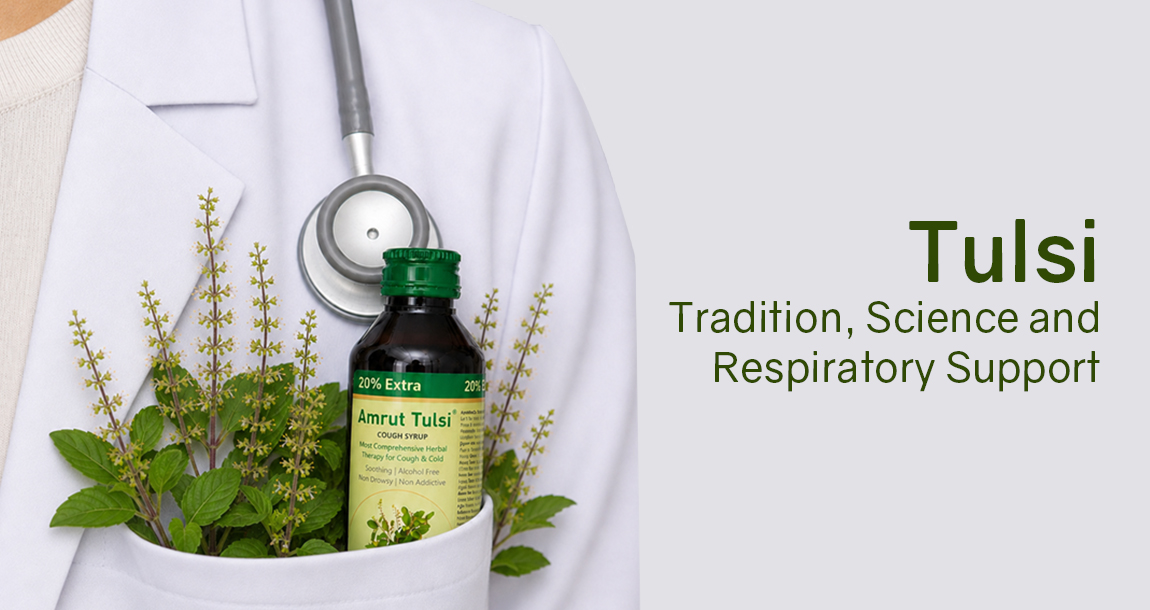
Tulsi has been used in Indian households and Ayurvedic practice for generations, particularly during seasonal changes, cough, throat irritation and respiratory discomfort. Contemporary research has also examined its phytochemicals and potential antioxidant, anti-inflammatory, antimicrobial and immunomodulatory properties.
However, traditional use, laboratory findings and proven clinical benefits are not the same. Understanding these differences allows Tulsi to be positioned responsibly—as supportive respiratory care rather than a replacement for diagnosis or established medical treatment.
What Is Tulsi?
Tulsi, commonly called holy basil, generally refers to Ocimum tenuiflorum L., also known by the synonym Ocimum sanctum L. It belongs to the Lamiaceae family. It is different from sweet basil, or Ocimum basilicum, commonly used in cooking.
Tulsi leaves contain naturally occurring plant compounds, including essential oils, phenolic compounds and flavonoids. The exact chemical profile may vary depending on the species, plant variety, growing conditions, plant part, extraction process and final formulation.
This variation is important. Scientific findings from one Tulsi extract cannot automatically be applied to every Tulsi tea, capsule, syrup, lozenge or concentrated extract.
Tulsi in Traditional Ayurvedic Respiratory Care
In Ayurveda, Tulsi has traditionally been used in preparations for cough, congestion, throat discomfort and seasonal respiratory complaints. Historical literature also describes its use in conditions such as bronchitis and asthma. These descriptions reflect traditional practice and should not be interpreted as proof of effectiveness according to modern clinical standards.
Traditional Tulsi preparations may be used to:
- Support throat comfort
- Help manage occasional cough
- Provide warmth during seasonal changes
- Complement rest and adequate fluid intake
- Support general respiratory wellness
- Reduce discomfort associated with exposure to cold weather or environmental irritants
Ayurvedic treatment is usually individualised. It may consider the nature of the cough, mucus, digestion, season, lifestyle and overall constitution rather than relying on one herb for every respiratory complaint.
What Does Contemporary Science Investigate?
Modern research has examined several biological properties of Tulsi. Much of this evidence comes from laboratory experiments, animal research or small human studies.
Antioxidant activity
Tulsi contains phytochemicals that have demonstrated antioxidant activity in experimental research. Antioxidants help control oxidative stress, a process involving unstable molecules that may damage cells.
This is biologically relevant because oxidative stress is associated with inflammation and many respiratory conditions. However, antioxidant activity in a laboratory does not prove that a Tulsi product can prevent or treat respiratory disease in people.
Anti-inflammatory activity
Experimental studies suggest that some Tulsi constituents may influence inflammatory pathways. This has led researchers to investigate whether Tulsi could support conditions involving inflammation or irritation.
The evidence is promising but incomplete. The effect may depend on the species, extract, dose and condition being studied.
Antimicrobial activity
Tulsi extracts and essential oils have shown activity against certain microorganisms in laboratory studies. These findings help researchers identify compounds that may deserve further investigation.
Laboratory antimicrobial activity does not mean that consuming Tulsi can cure a viral or bacterial respiratory infection. The concentration used in an experiment may be different from what is safely achievable in the human body.
Immunomodulatory research
Some studies have examined whether Tulsi affects immune responses. A systematic review of human Tulsi studies found favourable outcomes across several health areas, but it also noted limitations such as small study sizes, varied preparations and difficulty assessing the quality of some research.
Terms such as “supports immunity” must therefore be used carefully. Tulsi should not be promoted as providing guaranteed protection against colds, influenza, pneumonia or other infections.
Traditional Use and Scientific Evidence Are Different
| Evidence level | What it means |
| Traditional Ayurvedic use | Knowledge developed through historical practice and documented use |
| Laboratory evidence | Effects observed in cells, microorganisms or chemical tests |
| Animal research | Biological effects observed in controlled animal studies |
| Human clinical research | Effects measured in people |
| Established treatment evidence | Consistent findings from well-designed clinical trials and guidelines |
Tulsi has extensive traditional use and substantial experimental research. Human evidence exists, but product-specific, high-quality clinical trials for respiratory conditions remain limited.
This means Tulsi may have a role in supportive respiratory wellness, but it should not be presented as an established cure for respiratory infections or chronic lung diseases.
What Tulsi Can and Cannot Be Expected to Do
Tulsi-based products may support:
- Temporary throat comfort
- Relief from minor respiratory irritation, depending on the formulation
- Seasonal wellness routines
- Hydration when consumed in an appropriate warm preparation
- Complementary care under professional guidance
Tulsi should not be claimed to:
- Cure a viral infection
- Replace antibiotics when a bacterial infection requires them
- Treat pneumonia without medical care
- Replace asthma inhalers
- Prevent every cold or respiratory infection
- Cure tuberculosis
- Reverse chronic obstructive pulmonary disease
- Replace vaccination or emergency treatment
Breathing difficulty, wheezing, chest pain, high fever or a persistent cough requires assessment rather than continued self-treatment with herbal products.
The Amrut Tulsi Range
The Amrut Tulsi Range from Ikon Remedies presents Tulsi-based respiratory and wellness support in several convenient formats.
The range includes products such as:
- Amrut Tulsi Ark
- Amrut Tulsi Cough Syrup
- Amrut Tulsi Capsules
- Amrut Tulsi Plus Capsules
- Amrut Tulsi Kanth Sudharak Vati
- Amrut Tulsi Lozenges in different flavours
These formats allow product selection based on the intended use, age group, convenience and approved labelling. Ikon Remedies also offers Tulsi-based lozenges and traditional formulations positioned for throat and cough-related support.
Each product may contain different herbs, excipients and strengths. Therefore, the properties of Tulsi alone should not be used to describe the effects of the complete formulation.
All compositions, indications and directions should be checked against the latest approved Amrut Tulsi product label before publication or recommendation.
Why Product Quality Matters
Herbal-product effectiveness and safety depend on more than the name of the plant.
Important quality factors include:
- Correct botanical identification
- Plant part used
- Source of the raw material
- Extraction method
- Strength and standardisation
- Testing for microbes, pesticides and heavy metals
- Manufacturing controls
- Appropriate packaging
- Storage conditions
- Clear expiry information
Two products labelled “Tulsi” may differ considerably in concentration, purity and formulation. Choosing a product from a responsible pharmaceutical manufacturer helps provide greater consistency and traceability.
Can Tulsi Be Used with Modern Medicine?
Tulsi may be used as complementary care in selected individuals, but “natural” does not automatically mean suitable for everyone.
Patients should inform their doctor or pharmacist before using Tulsi products alongside:
- Blood-thinning medicines
- Diabetes medicines
- Medicines taken before surgery
- Long-term prescription treatment
- Other herbal products or supplements
Safety information during pregnancy and breastfeeding remains insufficient, and published reviews recommend caution.
Professional advice is also important for children, older adults and people with chronic liver, kidney, heart, respiratory or immune conditions.
When Respiratory Symptoms Need Medical Care
Seek prompt medical assessment for:
- Difficulty breathing
- Wheezing or chest tightness
- Chest pain
- Coughing up blood
- High or persistent fever
- Confusion or severe weakness
- Bluish lips
- Dehydration
- Unexplained weight loss
- Night sweats
- Cough lasting several weeks
- Symptoms that improve and then worsen
Tulsi-based supportive care should not delay testing or treatment for asthma, pneumonia, influenza, tuberculosis or another significant respiratory condition.
Conclusion
Tulsi occupies an important place in Ayurveda and Indian respiratory-care traditions. Contemporary research supports continued investigation into its antioxidant, anti-inflammatory, antimicrobial and immune-related properties, but the clinical evidence is not equally strong for every claim or respiratory condition.
The Amrut Tulsi Range brings traditional Tulsi-based care into modern formats, including Ark, capsules, syrup, lozenges and traditional throat-support preparations.
Its responsible role is supportive: helping provide throat and respiratory comfort according to the selected product’s approved use. It should complement—not replace—accurate diagnosis, prescribed treatment and timely medical care.